Thursday, January 25, 2007

Experience vs Income

What is more valuable, the experience you gather from working in a particular position or the compensation for the work you create?

Let's first isolate each variable, in order to distinguish there contents. First, you have experience, which combines the communication and technical skills, along with the cognitive and business skills that you gather while "experiencing" your job. As you gain more and more experience, your resume becomes more distinguishable and expanded. Experience is how you distinguish yourself from the competition, when interviewing and while moving up the corporate hierarchy. I consider noteworthy experience to be success on a major project that has direct business impact on your company. Other experience is more day-to-day work that can be summarized in a few sentences. Since this experience is what differentiates you and markets you to various audiences or employers, it is the major factor in granting you a high salary. Compensation is the capital you acquire from experience and accomplishments. The more experience, success and major projects that you are involved with, the more compensation you will obtain.

Conclusion: An increase in experience will yield an increase in job compensation.

What this means to you: Focus on gaining experience first and let your high salary follow!

Wednesday, January 17, 2007

Politics


You could be the hardest worker and have the most intellect in your selected field, but without strategic politics, you will not achieve your full potential. Politics, a factor that increases as company size increases, are relationship-centric. Remember always hearing "its not what you know, it's who you know," well that isn't completely true. If you are strong in politics, establish relationships amongst a broad network AND are intellectual and skilled in your position, then you will accelerate. Although, "who you know" takes precedent, if you are not a performer, you will not last in a new position.

Now you are wondering "how do I play politics." Politics is strategic and must be learned by experience in a work setting. Terms like "kissing up" or "brown-nosing" to superiors are part of politics, but it is more about displaying your talents to the right people at the right time, while praising their efforts. For those of you who feel they don't need to use this tactic to get ahead, then you are letting others steal the spotlight because the world runs on relationships and managers are looking for candidates that share similar views and work hard for "them".

At work you might notice politics when:
  • A co-worker compliments a managers work on a project.
  • Your in a meeting and a manager highlights a key point or view and a co-worker talks with the manager afterward, displaying agreement.
  • A display of an elevator-pitch to a manager in the hallway
In conclusion, your work ethic and intelligence will only get you so far. The relationships you create will enable doors to open rapidly.

Thursday, January 11, 2007

SWOT


Instead of basing a SWOT analysis around a product or competitor, let's focus it directly on you as an individual. Focus on maximizing your strengths, reducing your weaknesses, identifying opportunities and stabilizing threats. You may do an exercise, where you brainstorm and write down each of these areas, as they pertain to your current situation. Its all about strategizing ,through foreseeing the future through your current situation. Feedback is a great tool in order to uncover your weaknesses, while strengths are more apparent in your daily life. Opportunities and threats must be analyzed at a deeper level.
  • Strengths & Weaknesses: These areas are easily identified through feedback from others and your own view of yourself. Your goal should to be overcome your weaknesses by investing in education and to enhance or increase your strengths by gaining more real world experience.
  • Opportunities & Threats: Always be aware of currents threats, such as competitors in your organization or environmental factors that you may not control. Opportunities is the most important part of the equation because without opportunities, you will stay stationary in your current position. Opportunities are open doors, which allow you to progress or gain new experience in different fields or have mobility and move up.

Tuesday, January 09, 2007

Credibility

The term credibility essentially gravitates to those who understand the principles of marketing and apply the concepts in their lives. Credibility is what you are judged on and what your net value is based upon. It is also a measure of your comprehension of a particular field or practice. The more credibility you bring to the table, the better the chance you will have to succeed in any situation. It can be either spoken, written or personal, but it is formulated by perspective, relationships, knowledge of a field or work accomplished.

Credibility defined: the quality of being believable or trustworthy

If you examine this definition closely, the word trust is mentioned. The idea here is that if your manager trusts and believes you will accomplish a task, then you have credibility on your side. Without the credibility, you might not even get assigned a specific task or even obtain a job. Credibility must be earned, just as your trust in another person must be earned over time. The more credible you are, the more responsibility that your manager will trust you with. Credentials, such as the very elements you would view on a resume, forecasts credibility but is not the only indicator, which is why you still must prove yourself.

As a brand, you must establish a line of credibility with your peers and co-workers, so that they entrust you with projects and the ideas you conceive. Without this element, you will have no mobility or success in life. Credibility is centric in order to build your brand and push your career further.

Losing credibility is losing trust and losing trust is losing a job.

Tuesday, December 26, 2006

4 P's

I view this blog as a way to approach life, while integrating marketing concepts and applications. The foundation of marketing lies with the four p's, as you may already know. If you were to sell a new product, you would start to describe the product, your convenience to your community, low price point and promotional tactics of attracting this audience. Without the product and strategy, the other P's cannot function as once succinct unit. Let me break down this chart and describe to you how it relates to your life.


Product: Instead of selling an object, you are selling yourself, so therefore you become the product being sold. You have many attributes or characteristics that may differentiate yourself from the competition and make you who you are. The idea here is that you must build your product and establish a line of credibility. In order to build your product, you should educate yourself through schooling and work experiences and the vast array of knowledge that swarms you in your everyday life. BUILD YOUR BRAND and become a marketable "product."

Place: Now that you have built your brand(yourself), decide where you would like to showcase it or who your target market is for presenting it. These would be companies where you would like to work, whether close or far from your current location. DECIDING ON THE RIGHT PLACE will translate into an enriching experience that will also build your product.

Price: The price in this equation is your net value that you could provide to a company. Your value is encompassed by your wealth of knowledge, title, and years of experience that you bring to the table. As your value increases, so can your asking price for starting salaries. MATCH YOUR EXPERIENCE TO A PRICE.

Promotion: The promotion area of the four p's gravitates towards tactics that define how you get the job you desire. These tactics should be both creative and intuitive and should take into account the other 3 p's in order to be effective. CREATIVELY PROMOTING YOURSELF will enhance your visibility and generate positive responses if successful.

Saturday, December 23, 2006

A new year with new opportunities

Summary: After some initial research, it seems like the job market is further developing for 2007. If you are a graduating senior, there will be ample opportunity to acquire a desired position. The salary range for certain majors, has broadened from 2006 and expect growth for 2007. The demand for certain majors, such as IT and auditing are ever increasing, while majors such as engineering remain constant. Entry-level sales positions will have increased salaries and higher commissions.

Suggestions: Although there are new opportunities and wages have increased, competition has also increased at an even higher rate. Saying this, it is still necessary to put in that extra effort to get yourself ahead of the curve. I would suggest meeting with a career adviser, preparing your resume ahead of time, engage in practice interviews and plan your strategy accordingly. Your adversaries for your desired jobs will be taking the same kind of initiative, so you must position yourself with more experience and skills. Those that will pull the higher salaries in each range, are the ones that work the hardest, establish the key relationships and interview properly.

"Overall, 52 percent of employers responding to the Job Outlook 2007 Fall Preview Survey reported that they expect to hire more new college graduates in 2006-07 than they hired in 2005-06. While that number is down from the 66.5 percent of employers that planned to increase hiring last year, the number of employers that expect to decrease hiring this year is just 5.4 percent compared to 18.2 percent last year. The remaining 42.6 percent plan to maintain their hiring numbers, making an impressive jump from 15.3 percent in the Job Outlook 2006 Fall Preview Survey. "
Source: http://www.jobweb.com/joboutlook/2007/fall_outlook.htm


Salaries by title (entry-level)
  • Marketing associate: 30,000 - 50,000
  • IT Associate: 40,000 - 60,000
  • Financial Analyst: 48,000 - 58,000
  • Accountant: 42,000 - 60,000
  • Sales Consultant - 40,000 - 50,000

Thursday, December 14, 2006

Marketing is life

Ask these following questions to yourself:
  • Why do I choose to purchase the items or brands that I do? What creates this preference?
  • What drives the decision making in my life?
  • How do people perceive me and what do they base these views on?
  • Am I being controlled by the organizations that surround me?
  • What do employers base their decisions on? How can I position myself accordingly?
The decisions that you contrive and the life you live is all affected by marketing, in its entirety and cannot be escaped, unless you shut yourself off from the world that surrounds you. You are judged based on perception and that perception is regulated by how well your "market" yourself to others or convince them that you "fit the part" or are deserving of their time. The media drives its content and targets it directly at you throughout your life in many different fashions. They utilize media outlets, such as television, magazines, the internet, billboards, subways and promotional material such as coupons, in order to entice your purchasing habits and control your way of life. Some might believe this invades our privacy or feel that is a negative habit that constantly affects our lives. Numerous people think that commercials are a plain waste of time. I will not argue any of these conversations, BUT I do believe we can use marketing in order to promote ourselves and be successful in our own lives.

Think of yourself as a brand and marketing as a tool you can use in order to generate influence and success. If you view yourself as one of these companies that try and convince and entice others to "invest" in them, you will do quite well. Your goal should be to have others "invest" in you, in terms of money, time, and opportunities that may arise.

Monday, December 04, 2006

Positioning yourself

Positioning is a marketing term you may often be exposed to in business. The term actually ties in multiple concepts that factor into a competitive approach that you can use to your advantage. The word touches upon differentiation and mapping out where you or your company stands relative to competitors. The example above depicts a positioning map, where an employee is judged on both his or her technical skills and communication ability. The ideal goal an individual should have is to position him or herself in the upper right corner. Use this example to plot your fellow co-workers, whom also seek higher positions within your department. If they are closer to the upper right hand corner, than figure out what technical and communication skills are required to pull yourself up. Another key idea about positioning are differentiation strategies that allow you to stand out amongst your peers. Start brainstorming and researching which skills will suit your interests and what skills others do not hold. Position yourself as a hard worker, an intellectual and someone who can form relationships in order to be successful. With positioning, everything is relative and you will be "graded" relative to your peers, so be careful how you interact with them. You should try not to give away too much of your strategy, but learn to work with them to uncover some of theirs.

It is my goal to educate you on these strategies because I live them each and every day. The object of each of these posts is to infuse your mind with knowledge and to get you THINKING. It may take years to position yourself effectively and to acquire the right skills through training sessions, but there is a high payoff. Positioning revolves around how you present yourself relative to those around you, so make sure you start paying attention to these conditions and research techniques to get ahead.

Questions to ask yourself
  1. How do I position myself relative to the competition?
  2. What unique characteristics and/or technical abilities do I have?
  3. What are others doing that I'm not doing?
  4. Where do I find the resources necessary to succeed?
  5. How far will I go to succeed?

Wednesday, November 29, 2006

Knowledge Worker

There are two types of workers: regular and knowledge. Regular employees will remain stationary and unaffected by organizational change. In this fashion, they will pass on learning new technologies and strategies in order to conduct business more efficiently. The end result of a regular employee is to become obsolete in his or her current environment. In order to stop these coincidences from occurring, you must transition your train of thought to become a knowledge worker. Knowledge workers seek to acquire newly established skills and broaden their working capacity by soaking in new forms of knowledge and technology. To become a knowledge worker, you must look towards the future and have an inborn ability to excel at work. If you're a regular worker, your skills will slowly deplete over a period of time and your position will fade away. On the other hand, if you're a knowledge worker, you will acquire a variety of different skills and techniques that match the requirements of new positions that may unfold.

Tip: Research new skills and techniques that factor into your job situation and implement a strategy to acquire them. ALWAYS BE THINKING IN THE FUTURE!

Friday, November 24, 2006

Point method


Point A consists of your current knowledge base, combined with all experiences you've had leading up to today. Point B is your goal and cannot be attained without significant effort on your part. Each red bracket is an obstacle you must face in order to advance to point B. In life, you cannot progress from point A to point C, without first touching upon point B.

So you must be wondering what tactics and strategy must be preserved in order to conquer in order to advance to point B. The first step, is to identify the obstacle as a whole and the different variables that affect the outcome of your choice of solution. Next, brainstorm numerous steps in order to solve the underlying problem. Once you have done this, choose the best solution and execute your strategy. Take your goals step by step and don't skip steps, unless you are given the opportunity.

Success will come to those that can identify what point A and point B is and map out strategies to accelerate.

Monday, November 20, 2006

Spheres of Influence


Your organization is constructed so that you start on the bottom and must work your way up to the top. This is easier said than done and while you are the only person that may work to get there, you can't possibly accomplish it all yourself. Life is about credibility, which is the way you portray yourself to others, in order for them to build confidence and trust with your work. You must form relationships with others who are well established, in order to establish yourself with your own unique credentials. Convince your manager and others that you have what it takes and display both your intelligence and communication skills to all of them. The more people that are in your "sphere of influence", the greater chance you have at obtaining a promotion or earning the respect of your colleagues. The goal of a "sphere of influence" is to capture the minds of as many of your fellow employees as possible and to convince them that you understand your core work disciplines and are detail-oriented. This could involving merely a presentation, which includes many employees at once or individual meetings. The more people that fall under this sphere, the greater the chance you will succeed (among other variables). Furthermore, the object is to get managers under your sphere because they have large spheres of influence accounted for, so if you can convince them, it will also convince a larger body of your company. Find ways to interact with your fellow employees and network into other groups cross-functionally.

Note: Connect the sphere of influence to a mere networking tactic and you will realize the potential you have to succeed.

Thursday, November 16, 2006

The success sacrifice

"Your role may be thankless, But if you're willing to give it your all, you just might bring success to those who outlast you."

To get what we really seek in life, we must have points of sacrifice. By "sacrifice" I mean, giving up one thing, in order to obtain another. For example, if you strive to get a promotion at work, you may sacrifice precious hours you might have spent with a loved one. This is in fact an opportunity cost in itself because in order for you to attain an opportunity, there is a cost associated with it. Costs usually account for time, money, effort and endurance and benefits can range from a promotion to a successful relationship. To make things truly work out, one must lose out on one opportunity.

You might be saying to yourself right now "I've never had to sacrifice." I will counter this thought by explaining to you that the event of even attending a college is a sacrifice and you must endure four years of hard work to either progress into graduate school or get a superior job. Instead of going to college, you may have stayed stationary at home or took up a moderate job that barely pays the bills. Have you ever driven lengths to see the woman you love? A relationship in its essence reflects sacrifice and builds off this element to be successful. If two people are willing to sacrifice to be with each other, then it must be true love. If you are willing to put in the effort to graduate at the top of your class (as a sacrifice) then you will attain a superior job.

As a rule of thumb, the more you sacrifice early in life, the more benefit you will receive later. This is a judgment call that you must make. I interned eight times throughout the past 5 years, as a sacrifice and because of that sacrifice, I claimed a job that fit both my expectations and requirements. The sacrifice here was time and effort and it paid off. If you have the determination and are willing to work for something and sacrifice, you will get what you want.

Thursday, November 09, 2006

A resume is a story

What is a resume? The majority of the population view a resume as a piece of collateral that is a prerequisite for obtaining an interview. Those who have enriched resumes, will be granted an interview and those with resumes that are inadequate will lose opportunities. Today I would like to share my philosophy for creating a superior resume and the logical flow behind it.

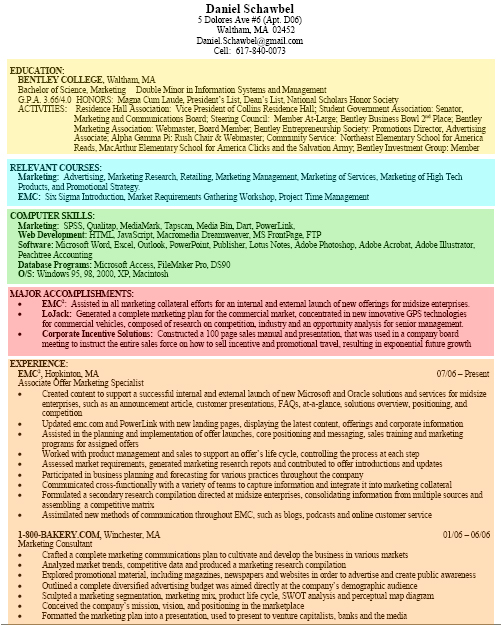
A resume is a story. More importantly, it is a story of your life, including your college experiences, as well as your work experiences. Think of a resume as a detail description of all that you have accomplished thus far in your lives. So you might ask "how do I shape my experiences chronologically in order to be most effective?" To have the most impact with your resume, there must be some logical flow behind it. I will now walk you through my resume as an example.
  1. Education: Start off by describing your experiences at college because it is the foundation for which you will enter your careers. Include your major, gpa (if 3.0 or higher), activities & leadership positions and any honors.
  2. Relevant Courses: So after you lay out the statistics and qualitative information to give credibility, the courses you take in college help demonstrate that you have learned information in your field.
  3. Technical Skills: I'm an employer and i've seen that you have gone to the same college as most of the other applicants and have taken similar courses. Having the right technical skills infuses your expertise level and allows you to accelerate in desired positions. You have already listed your overall background (education), so take the time to list out skills that have helped you accomplish this education.
  4. Major Accomplishments: This area is brand new to my resume. If you haven't had any major accomplishments, feel free to list a school related project. This area is good for a reviewer who doesn't have time to read your entire resume.
  5. Experience: This area is a representation of your work experience history, from present to past, which is a story in itself. This area of your resume is by far the most critical to you landing that much anticipated job req. Make sure to connect your work experiences into your education and so forth. If you can cross apply your learnings, you should have superior interviews.

Tuesday, November 07, 2006

5 Inputs of Success

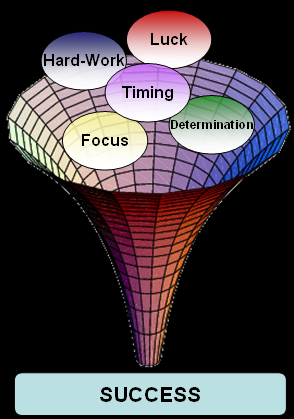
Focus: Find a subject that interests you, focus in on it and then figure out how to position yourself accordingly, in order to step into that field. Those who have focus, do not waste precious time on subject matter that is not relevant. My tip here is to do your homework by researching different job positions, qualifications and responsibilities to get a strong handle on relevancy to what you want to accomplish. If you are passionate about creating custom graphics, then maybe try your hand at advertising. Focus is what will help drive you!

Luck: To me luck is a "wild card" because fortune may change all other successful inputs accordingly. You could have the most determination in the world, focus on your goals and work hard, but if your company acquired, then you might lose out. Luck is something that cannot be changed or manipulated, but if you are lucky, the doors may open to new opportunities.

Hard-work: If you work hard, it shows in the quality of the end deliverable. Working hard is a characteristic of any successful entrepreneur. If you are not willing to work hard, then it is actually considered an impediment to your success and a competitive disadvantage. If you aren't working hard, others will be working hard, so they will climb the corporate hierarchy while you remain stationary. Remember you "get out of life what you put in."

Determination: Determination is the driver to make someone work hard and the force is very strong. If you are determined, you will not let any obstacle force you to quit and in doing so, you will be successful. On the downside, this attribute may make you go crazy, which is certainly not healthy to your lives. Find something inside you where you can get this characteristic and "ignite it."

Timing: Timing correlates almost directly with luck, in that if you have superior timing, the right positions or opportunities will clear and allow you to seize them. The difference between timing and luck is that you have the inborn ability to control timing. I say this because you can get your work out to your boss at the right time and manipulate the system.


I hope you all enjoyed this post....leave a comment if something is unclear!

NOTE: I create all the graphics used in the blog if you were wondering

Friday, November 03, 2006

Giving back

Throughout your life, you have viewed others helping nearby communities, donate to charities and volunteer to support local causes. There is a reason for all of these acts and although it seems obvious, I consider the act of giving and receiving a life cycle. Giving back, in my opinion, solidifies your future successes because helping other people that are not as fortune as you may be is what everyone should do. Charities are not the only form of "giving back." I also consider helping your families, a major part in the giving back process. Psychologically, if you are fortune, are highly successful and stable, why not help those that could die without your financial support.

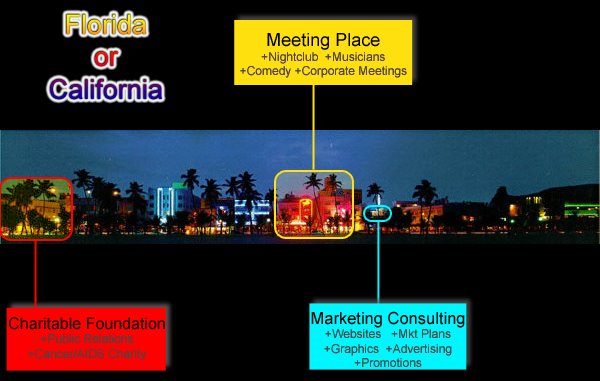
In the previous post, you may have noticed that I included a charitable foundation, as part of my dream. If you retire and have an outstanding balance of cash flow, it serves no purpose, other than utilizing it to give back to the communities and people that have made you who you are.

So if you take nothing from this post, I would like you to take a look around your world and see how you could make the most impact, by helping others out in need. Understand that the people that have guided you, appreciated you and care for you, should be taken up with you in your success and the people that have held you back and who did not believe in you should be banished.

Wednesday, November 01, 2006

If you can dream it...you can do it

I finally put all my dreams together and modeled it for all of you to see. There is of course logic as to why I want to own a "meeting place", charitable organization and consulting firm, but you will just have to figure that out on your own. This post is supposed to get you thinking about your future, noting where you are now, and the steps you need to take in order to accomplish your dreams. Personally, when I want to accomplish something at this level, I will usually make it happen over time because I never give up. So take a moment and think about where you want to end up in the future......


Remember that you can accomplish anything you desire, as long as you put in the effort and don't give up. DO NOT let anyone tell you otherwise!

Sunday, October 29, 2006

Overcoming Obstacles

In our lives, there have always been obstacles or threats that hinder our success. In order to properly overcome these obstacles, we must first state the various threat possibilities that we notice every day. Here are some of a few (pertaining to success in the workplace):
          • Parents
          • Peers
          • Opportunity Limitations
          • Poor Management / Mentoring
          • Company Politics
          • Uncontrollable External Factors (such as the weather)
After presenting your current obstacles, you must figure out tactics and strategically align these tactics to manipulating these obstacles in your favor or dismissing them altogether. One factor which we may never control is "luck", which forecasts the probability for which we will succeed. Luck is always the wild card and plays a major role in upward job mobility. As you age, parents become less and less of a factor into blockading your future and sending it in the direction they desire. Although, they do pose as mentors with previous experience that may lend a hand. Peers are tricky adversaries and mercenaries to your cause because some of your friends will be trying to utilize you as a resource to get ahead on their career path, while others may aid your cause. Your opportunities may be limited by the total allotment of revenue generated by your department or "value-add". By this I mean that the strength of your department to contribute to the company's bottom line, will initiate key opportunities for you or the lack there of. A manager is crucial to your success and if the manager lacks key skills and interpersonal communication, then you are already at a loss. It is quite hard to excel if your manager is an obstacle point of contact, so you must work around that and establish other mentors that could guide you in the right direction. Company politics are inevitable, especially at a larger corporation, where the hierarchy is limitless and the competition is strong. The only way to combat this obstacle is to play into it. External factors may not be controlled, and might have a negative impact on your work if you let them. As long as you work around these obstacles, you will be able to achieve, without constant frustration that negatively impacts your work progress.

Wednesday, October 25, 2006

Climbing the corporate ladder


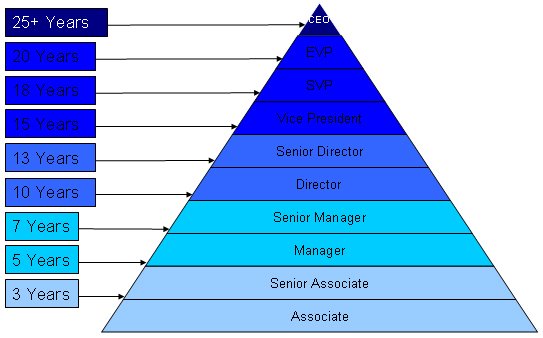
This pyramid represents the routine transition from new employee, into management, into director, vice president and then as CEO. If you seek to be at the top, you must visualize the steps beneath and the imagery above should give you a more defined picture. Of course, there are special circumstances, that usually involve timing and a bit of luck, such as employees switching to new departments or your division prospering. Managers, directors, vice presidents or even the CEO might leave the position, allowing an understudy to fill in. Also, your division might be highly successful (in terms of revenue generated) one year and the CEO might want to invest more money and labor into it, meaning you will have direct reports, giving you a boost into management. In general if you would like to be CEO or even merely a manager, the diagram above gives an accurate read of how many years of experience you must have in order to be in the selection pool. If you think that you could be a manager after only a year, you are wrong because you will not have the full understanding of your field in only one year and will not have earned the respect as a new employee to handle that position. There are leadership development programs that allow you to successfully push up the pyramid at a faster pace, but otherwise, you must start from the bottom and work up, gaining valuable experience at every step of the way. Not everyone wants to step into management. Management means more responsibilities, more stress, and more time away from your friends and families. This blog is more geared to those who wish to stop at nothing and create upward mobility in order to accomplish at the highest level. If you want to do this, you MUST put in the time, the effort and most importantly the realization that others are seeking the same goals as you are. Just keep focused and you will climb the ladder over a period of time.

Sunday, October 22, 2006

Act the part


Ever wonder which employees get promoted to management and which stay stationary at their current positions? This question has posed a lengthy debate for a long time for me. I used to think that working hard, accomplishing your organizational goals and establishing relationships was the path towards escalation up the corporate hierarchy. My new thoughts are that if you act the part, then your one step closer to being the part. By this I mean that if you start acting like a manager by facilitating communication across corporate lines, managing work flow processes and creating a work environment where others depend on your work to get their own jobs accomplished. Acting the part, will not only display your ability to handle management, but also almost force your manager or director to enlist you in the position.

This is obviously not an easy task to do and it requires a lot of determination, tactical planning and opportunity. You must be given the opportunity to carry on a wider variety of work and the ability to cover more portions of the business, in order to move up the ladder. Other factors that play a role in this are age, years of service at the company, manager’s perspective over your capabilities and positioning within your department. Be aware that others will be competing for management positions as well, so always display that you are more suitable for the job.

Strategy: Validate with your manager that you are able to handle a wide variety of work, outside of your realm of day-to-day operations.

Tuesday, October 17, 2006

Success is in Process

Improving the process of your job will compliment the success of your business. Have you ever been frustrated from countless engagements with management in order to get something approved? If you answered "yes", then you understand that there must be a more efficient process and selection criteria for accomplishing ones job. The Six Sigma practice has been adopted by various companies encouraging employees to adopt a new process for achieving their goals. As methodological as this may be, the main idea here is to debrief your job each quarter and reflect back as to what worked and what didn't.

In order to enhance the process, you must see fault or failure in the previous process. Start by writing down the steps you had to take in order to accomplish your task, including channel of communication and time allotment. Next, put these in order and then subtract steps that either overlapped or weren't crucial in the final product. Once you have your final listing, set up a meeting with your manager and review the new process and then implement it in the following quarter. In the aftermath, you should compare results from quarter to quarter, to constantly improve productivity. Saying this, I believe that if you follow this guide, you will not only be a better worker, but it will allow you to diversify yourself in other areas of the business because of an increase in free time. Concurrently improving processes, enhances your status and cuts both costs and time.