
Sunday, March 18, 2007
Monday, March 12, 2007
Setting yourself up for success
You just received a project due in 5 days. How will you accomplish this goal in a timely manner and deliver?
It's all about setting yourself up for success, so that you deliver the best possible content in a 5 day span, and actually finish it before it's due. This way, it will allow leway between edits and completion. The strategy for accomplishing this is to establish a project plan that spans 5 days. The plan should include all the work that needs to get done, in order to finish the project on time, as well as periods where certain portions of the project need to be complete. Once you have established this plan, you need to follow it for the 5 days.
If this is a collaboration effort, you must include the other "stakeholders" in your plan, and mark the days in which they need to take part in this initiative. If they have to sign off on pieces of the project or the entire project, mark these gates on your plan. If it is a long-term plan, you may included phases or draft cycles. The important thing to consider is how complex the project is and the audience it is being provided to. After you know those pieces, you can construct the project plan to meet the needs and requirements of the audience. Make sure you communicate this plan with the stakeholders of the project, so that everyone is on the same page.
To properly set yourself up for success, you should bring the due date of the project to at least 1 day before it is due. This will provide pressure at first, but you will have less stress closer to the deadline.
A good tool to use to create plans, such as the one described above is Microsoft Project, which is project management software designed to track the progress of a project and attach resources and deadlines.
It's all about setting yourself up for success, so that you deliver the best possible content in a 5 day span, and actually finish it before it's due. This way, it will allow leway between edits and completion. The strategy for accomplishing this is to establish a project plan that spans 5 days. The plan should include all the work that needs to get done, in order to finish the project on time, as well as periods where certain portions of the project need to be complete. Once you have established this plan, you need to follow it for the 5 days.
If this is a collaboration effort, you must include the other "stakeholders" in your plan, and mark the days in which they need to take part in this initiative. If they have to sign off on pieces of the project or the entire project, mark these gates on your plan. If it is a long-term plan, you may included phases or draft cycles. The important thing to consider is how complex the project is and the audience it is being provided to. After you know those pieces, you can construct the project plan to meet the needs and requirements of the audience. Make sure you communicate this plan with the stakeholders of the project, so that everyone is on the same page.
To properly set yourself up for success, you should bring the due date of the project to at least 1 day before it is due. This will provide pressure at first, but you will have less stress closer to the deadline.
A good tool to use to create plans, such as the one described above is Microsoft Project, which is project management software designed to track the progress of a project and attach resources and deadlines.
Saturday, March 03, 2007
Goal Alignment
 Your goals are how you measure success. They are the objectives you set for yourself, either in the short-term or long-term of your career. When you evaluate your goals, make sure they are attainable and are noteworthy. For instance, if you want to be an accountant, your short term goal could be go obtain your CPA or to get your masters in accounting. Short-term goals could last anywhere from a few days to a few years, depending on your situation and requirements. With long-terms goals, you are looking out into the future, as to whom you would like to be in 10 - 20 years, what your desired job might be or where you will relocate to. These are all decisions you will make over a period of time, based on your current situation and your desired outcome. By creating your goals, you are giving yourself something to measure success and achievement.
Goal alignment is critical to the achievement of long-term goals. Short-term and long-term goals must be aligned, which will create an underlying strategy that you will live by. For instance, if you are destined to be a Lawyer, you notice that you will need some additional education and a possible internship to get into that field. Those are both your short-term goals and your long-term goal might be to have your own practice. The key is that both align, and that your short-term goals support the overall effort, so that you end up where you want to be.
Saturday, February 24, 2007
Recruiting Process: Simplify your time

Ever wonder why your friends are seizing job opportunities, while you are researching hours each day and applying to multiple jobs with no results?
Networking allows for ease in this process, and by connecting with a professional in your desired work space, you have:
- less pressure
- more credibility
- possibly less interviews / time to interview
- better chances
It all starts with your network, including your family, friends, teachers and co-workers then it is expanded by their network. So ask them who they know and then ask those people who they know. It is one large cycle and the larger the network you have, the more opportunity at your gate. This is also a reason why people join organizations, because they are networks segmented to your very interests. Find people in your field that have a similar interest and are older than you, so they can mentor you into those positions.


Saturday, February 17, 2007
Leverage: Doing more with less
 "Leverage" is a popular vocabulary word in the corporate world. Why is this? Because it is strategic and allows a single person to utilize all the resources around him or her most effectively and efficiently in order to have a positive impact on the bottom line.
What we leverage:
- People or human resources - people are resources that can accomplish tasks or provide information that has already been gathered (research)
- Research - from a known source or reporter such as Forrester or Gartner. Research could be gathered through various websites online, but they aren't all "trusted" so be warned.
- Capital - money doesn't buy happiness, but it can be "leveraged" to create value for the customer or client
- Ideas - derived from people and can be "leveraged" to create a successful strategy
- Assets - aside from monetary means, assets could be classified as a location such as a house (place of ownership)
Friday, February 09, 2007
Resources: The building blocks of power
How does one gain power and success?
Resources in nature cover the areas of people, money and materials. These three areas allow one person to have more control than another. The more wealth, raw materials and people you have working for you, the more powerful you will be. When I mention power, I mean the ability to gain control in a certain area, whether it be management or the creation of a separate business entity. Resources are the gateway to overcoming adversity and climbing new heights.
Resources in nature cover the areas of people, money and materials. These three areas allow one person to have more control than another. The more wealth, raw materials and people you have working for you, the more powerful you will be. When I mention power, I mean the ability to gain control in a certain area, whether it be management or the creation of a separate business entity. Resources are the gateway to overcoming adversity and climbing new heights.
- To have more people working for you or at your disposal, means you can get more things done and in a timely manner.
- To have more raw materials, means you can create more product to sell to the end consumer.
- To have more money, means you are able to purchase more materials and pay the wages of your underlings.
Sunday, February 04, 2007
Timing and the open door
 So you have all the right skills, know all the right people and have proven your capabilities. You may wonder why you haven't progressed and furthered your career, while having all of these strengths work in your favor. The one element that is missing from the equation is "the open door" meaning, the timing and luck required for the door to open and an opportunity to emerge. You could be the most qualified candidate in the world, but if senior management remains stagnant, you will remain immobile. Furthermore, when a door opens, if you have these skills and connections, then you will be the best candidate to walk through the door into a new opportunity and position within your company. Candidates that excel and work hard, will be unnoticed if they don't prove themselves to the appropriate managers. Managers who seek further advancement, may opt to pull you in the right direction as well, possibly taking their old position. As with anything else in life, the corporate world is all a game and the pieces constantly move. When the door does open, you must strike and claim the opportunity before the competition does. Research opportunities, communicate interest, prove yourself and build relationships if you want to be the candidate to accelerate and be at the front of the line when the door opens.
Thursday, January 25, 2007
Experience vs Income
 What is more valuable, the experience you gather from working in a particular position or the compensation for the work you create?
Let's first isolate each variable, in order to distinguish there contents. First, you have experience, which combines the communication and technical skills, along with the cognitive and business skills that you gather while "experiencing" your job. As you gain more and more experience, your resume becomes more distinguishable and expanded. Experience is how you distinguish yourself from the competition, when interviewing and while moving up the corporate hierarchy. I consider noteworthy experience to be success on a major project that has direct business impact on your company. Other experience is more day-to-day work that can be summarized in a few sentences. Since this experience is what differentiates you and markets you to various audiences or employers, it is the major factor in granting you a high salary. Compensation is the capital you acquire from experience and accomplishments. The more experience, success and major projects that you are involved with, the more compensation you will obtain.
Conclusion: An increase in experience will yield an increase in job compensation.
What this means to you: Focus on gaining experience first and let your high salary follow!
Wednesday, January 17, 2007
Politics

You could be the hardest worker and have the most intellect in your selected field, but without strategic politics, you will not achieve your full potential. Politics, a factor that increases as company size increases, are relationship-centric. Remember always hearing "its not what you know, it's who you know," well that isn't completely true. If you are strong in politics, establish relationships amongst a broad network AND are intellectual and skilled in your position, then you will accelerate. Although, "who you know" takes precedent, if you are not a performer, you will not last in a new position.
Now you are wondering "how do I play politics." Politics is strategic and must be learned by experience in a work setting. Terms like "kissing up" or "brown-nosing" to superiors are part of politics, but it is more about displaying your talents to the right people at the right time, while praising their efforts. For those of you who feel they don't need to use this tactic to get ahead, then you are letting others steal the spotlight because the world runs on relationships and managers are looking for candidates that share similar views and work hard for "them".
At work you might notice politics when:
- A co-worker compliments a managers work on a project.
- Your in a meeting and a manager highlights a key point or view and a co-worker talks with the manager afterward, displaying agreement.
- A display of an elevator-pitch to a manager in the hallway
Thursday, January 11, 2007
SWOT

Instead of basing a SWOT analysis around a product or competitor, let's focus it directly on you as an individual. Focus on maximizing your strengths, reducing your weaknesses, identifying opportunities and stabilizing threats. You may do an exercise, where you brainstorm and write down each of these areas, as they pertain to your current situation. Its all about strategizing ,through foreseeing the future through your current situation. Feedback is a great tool in order to uncover your weaknesses, while strengths are more apparent in your daily life. Opportunities and threats must be analyzed at a deeper level.
- Strengths & Weaknesses: These areas are easily identified through feedback from others and your own view of yourself. Your goal should to be overcome your weaknesses by investing in education and to enhance or increase your strengths by gaining more real world experience.
- Opportunities & Threats: Always be aware of currents threats, such as competitors in your organization or environmental factors that you may not control. Opportunities is the most important part of the equation because without opportunities, you will stay stationary in your current position. Opportunities are open doors, which allow you to progress or gain new experience in different fields or have mobility and move up.
Tuesday, January 09, 2007
Credibility
The term credibility essentially gravitates to those who understand the principles of marketing and apply the concepts in their lives. Credibility is what you are judged on and what your net value is based upon. It is also a measure of your comprehension of a particular field or practice. The more credibility you bring to the table, the better the chance you will have to succeed in any situation. It can be either spoken, written or personal, but it is formulated by perspective, relationships, knowledge of a field or work accomplished.
If you examine this definition closely, the word trust is mentioned. The idea here is that if your manager trusts and believes you will accomplish a task, then you have credibility on your side. Without the credibility, you might not even get assigned a specific task or even obtain a job. Credibility must be earned, just as your trust in another person must be earned over time. The more credible you are, the more responsibility that your manager will trust you with. Credentials, such as the very elements you would view on a resume, forecasts credibility but is not the only indicator, which is why you still must prove yourself.
As a brand, you must establish a line of credibility with your peers and co-workers, so that they entrust you with projects and the ideas you conceive. Without this element, you will have no mobility or success in life. Credibility is centric in order to build your brand and push your career further.
Credibility defined: the quality of being believable or trustworthy
If you examine this definition closely, the word trust is mentioned. The idea here is that if your manager trusts and believes you will accomplish a task, then you have credibility on your side. Without the credibility, you might not even get assigned a specific task or even obtain a job. Credibility must be earned, just as your trust in another person must be earned over time. The more credible you are, the more responsibility that your manager will trust you with. Credentials, such as the very elements you would view on a resume, forecasts credibility but is not the only indicator, which is why you still must prove yourself.
As a brand, you must establish a line of credibility with your peers and co-workers, so that they entrust you with projects and the ideas you conceive. Without this element, you will have no mobility or success in life. Credibility is centric in order to build your brand and push your career further.
Losing credibility is losing trust and losing trust is losing a job.
Tuesday, December 26, 2006
4 P's
I view this blog as a way to approach life, while integrating marketing concepts and applications. The foundation of marketing lies with the four p's, as you may already know. If you were to sell a new product, you would start to describe the product, your convenience to your community, low price point and promotional tactics of attracting this audience. Without the product and strategy, the other P's cannot function as once succinct unit. Let me break down this chart and describe to you how it relates to your life.

Product: Instead of selling an object, you are selling yourself, so therefore you become the product being sold. You have many attributes or characteristics that may differentiate yourself from the competition and make you who you are. The idea here is that you must build your product and establish a line of credibility. In order to build your product, you should educate yourself through schooling and work experiences and the vast array of knowledge that swarms you in your everyday life. BUILD YOUR BRAND and become a marketable "product."
Place: Now that you have built your brand(yourself), decide where you would like to showcase it or who your target market is for presenting it. These would be companies where you would like to work, whether close or far from your current location. DECIDING ON THE RIGHT PLACE will translate into an enriching experience that will also build your product.
Price: The price in this equation is your net value that you could provide to a company. Your value is encompassed by your wealth of knowledge, title, and years of experience that you bring to the table. As your value increases, so can your asking price for starting salaries. MATCH YOUR EXPERIENCE TO A PRICE.
Promotion: The promotion area of the four p's gravitates towards tactics that define how you get the job you desire. These tactics should be both creative and intuitive and should take into account the other 3 p's in order to be effective. CREATIVELY PROMOTING YOURSELF will enhance your visibility and generate positive responses if successful.

Product: Instead of selling an object, you are selling yourself, so therefore you become the product being sold. You have many attributes or characteristics that may differentiate yourself from the competition and make you who you are. The idea here is that you must build your product and establish a line of credibility. In order to build your product, you should educate yourself through schooling and work experiences and the vast array of knowledge that swarms you in your everyday life. BUILD YOUR BRAND and become a marketable "product."
Place: Now that you have built your brand(yourself), decide where you would like to showcase it or who your target market is for presenting it. These would be companies where you would like to work, whether close or far from your current location. DECIDING ON THE RIGHT PLACE will translate into an enriching experience that will also build your product.
Price: The price in this equation is your net value that you could provide to a company. Your value is encompassed by your wealth of knowledge, title, and years of experience that you bring to the table. As your value increases, so can your asking price for starting salaries. MATCH YOUR EXPERIENCE TO A PRICE.
Promotion: The promotion area of the four p's gravitates towards tactics that define how you get the job you desire. These tactics should be both creative and intuitive and should take into account the other 3 p's in order to be effective. CREATIVELY PROMOTING YOURSELF will enhance your visibility and generate positive responses if successful.
Saturday, December 23, 2006
A new year with new opportunities
Summary: After some initial research, it seems like the job market is further developing for 2007. If you are a graduating senior, there will be ample opportunity to acquire a desired position. The salary range for certain majors, has broadened from 2006 and expect growth for 2007. The demand for certain majors, such as IT and auditing are ever increasing, while majors such as engineering remain constant. Entry-level sales positions will have increased salaries and higher commissions.
Suggestions: Although there are new opportunities and wages have increased, competition has also increased at an even higher rate. Saying this, it is still necessary to put in that extra effort to get yourself ahead of the curve. I would suggest meeting with a career adviser, preparing your resume ahead of time, engage in practice interviews and plan your strategy accordingly. Your adversaries for your desired jobs will be taking the same kind of initiative, so you must position yourself with more experience and skills. Those that will pull the higher salaries in each range, are the ones that work the hardest, establish the key relationships and interview properly.
"Overall, 52 percent of employers responding to the Job Outlook 2007 Fall Preview Survey reported that they expect to hire more new college graduates in 2006-07 than they hired in 2005-06. While that number is down from the 66.5 percent of employers that planned to increase hiring last year, the number of employers that expect to decrease hiring this year is just 5.4 percent compared to 18.2 percent last year. The remaining 42.6 percent plan to maintain their hiring numbers, making an impressive jump from 15.3 percent in the Job Outlook 2006 Fall Preview Survey. "
Source: http://www.jobweb.com/joboutlook/2007/fall_outlook.htm
Salaries by title (entry-level)
Suggestions: Although there are new opportunities and wages have increased, competition has also increased at an even higher rate. Saying this, it is still necessary to put in that extra effort to get yourself ahead of the curve. I would suggest meeting with a career adviser, preparing your resume ahead of time, engage in practice interviews and plan your strategy accordingly. Your adversaries for your desired jobs will be taking the same kind of initiative, so you must position yourself with more experience and skills. Those that will pull the higher salaries in each range, are the ones that work the hardest, establish the key relationships and interview properly.
"Overall, 52 percent of employers responding to the Job Outlook 2007 Fall Preview Survey reported that they expect to hire more new college graduates in 2006-07 than they hired in 2005-06. While that number is down from the 66.5 percent of employers that planned to increase hiring last year, the number of employers that expect to decrease hiring this year is just 5.4 percent compared to 18.2 percent last year. The remaining 42.6 percent plan to maintain their hiring numbers, making an impressive jump from 15.3 percent in the Job Outlook 2006 Fall Preview Survey. "
Source: http://www.jobweb.com/joboutlook/2007/fall_outlook.htm
Salaries by title (entry-level)
- Marketing associate: 30,000 - 50,000
- IT Associate: 40,000 - 60,000
- Financial Analyst: 48,000 - 58,000
- Accountant: 42,000 - 60,000
- Sales Consultant - 40,000 - 50,000
Thursday, December 14, 2006
Marketing is life
 Ask these following questions to yourself:
- Why do I choose to purchase the items or brands that I do? What creates this preference?
- What drives the decision making in my life?
- How do people perceive me and what do they base these views on?
- Am I being controlled by the organizations that surround me?
- What do employers base their decisions on? How can I position myself accordingly?
Think of yourself as a brand and marketing as a tool you can use in order to generate influence and success. If you view yourself as one of these companies that try and convince and entice others to "invest" in them, you will do quite well. Your goal should be to have others "invest" in you, in terms of money, time, and opportunities that may arise.
Monday, December 04, 2006
Positioning yourself
 Positioning is a marketing term you may often be exposed to in business. The term actually ties in multiple concepts that factor into a competitive approach that you can use to your advantage. The word touches upon differentiation and mapping out where you or your company stands relative to competitors. The example above depicts a positioning map, where an employee is judged on both his or her technical skills and communication ability. The ideal goal an individual should have is to position him or herself in the upper right corner. Use this example to plot your fellow co-workers, whom also seek higher positions within your department. If they are closer to the upper right hand corner, than figure out what technical and communication skills are required to pull yourself up. Another key idea about positioning are differentiation strategies that allow you to stand out amongst your peers. Start brainstorming and researching which skills will suit your interests and what skills others do not hold. Position yourself as a hard worker, an intellectual and someone who can form relationships in order to be successful. With positioning, everything is relative and you will be "graded" relative to your peers, so be careful how you interact with them. You should try not to give away too much of your strategy, but learn to work with them to uncover some of theirs.
It is my goal to educate you on these strategies because I live them each and every day. The object of each of these posts is to infuse your mind with knowledge and to get you THINKING. It may take years to position yourself effectively and to acquire the right skills through training sessions, but there is a high payoff. Positioning revolves around how you present yourself relative to those around you, so make sure you start paying attention to these conditions and research techniques to get ahead.
Questions to ask yourself
- How do I position myself relative to the competition?
- What unique characteristics and/or technical abilities do I have?
- What are others doing that I'm not doing?
- Where do I find the resources necessary to succeed?
- How far will I go to succeed?
Wednesday, November 29, 2006
Knowledge Worker
 There are two types of workers: regular and knowledge. Regular employees will remain stationary and unaffected by organizational change. In this fashion, they will pass on learning new technologies and strategies in order to conduct business more efficiently. The end result of a regular employee is to become obsolete in his or her current environment. In order to stop these coincidences from occurring, you must transition your train of thought to become a knowledge worker. Knowledge workers seek to acquire newly established skills and broaden their working capacity by soaking in new forms of knowledge and technology. To become a knowledge worker, you must look towards the future and have an inborn ability to excel at work. If you're a regular worker, your skills will slowly deplete over a period of time and your position will fade away. On the other hand, if you're a knowledge worker, you will acquire a variety of different skills and techniques that match the requirements of new positions that may unfold.
Tip: Research new skills and techniques that factor into your job situation and implement a strategy to acquire them. ALWAYS BE THINKING IN THE FUTURE!
Friday, November 24, 2006
Point method

Point A consists of your current knowledge base, combined with all experiences you've had leading up to today. Point B is your goal and cannot be attained without significant effort on your part. Each red bracket is an obstacle you must face in order to advance to point B. In life, you cannot progress from point A to point C, without first touching upon point B.
So you must be wondering what tactics and strategy must be preserved in order to conquer in order to advance to point B. The first step, is to identify the obstacle as a whole and the different variables that affect the outcome of your choice of solution. Next, brainstorm numerous steps in order to solve the underlying problem. Once you have done this, choose the best solution and execute your strategy. Take your goals step by step and don't skip steps, unless you are given the opportunity.
Success will come to those that can identify what point A and point B is and map out strategies to accelerate.

Monday, November 20, 2006
Spheres of Influence

Your organization is constructed so that you start on the bottom and must work your way up to the top. This is easier said than done and while you are the only person that may work to get there, you can't possibly accomplish it all yourself. Life is about credibility, which is the way you portray yourself to others, in order for them to build confidence and trust with your work. You must form relationships with others who are well established, in order to establish yourself with your own unique credentials. Convince your manager and others that you have what it takes and display both your intelligence and communication skills to all of them. The more people that are in your "sphere of influence", the greater chance you have at obtaining a promotion or earning the respect of your colleagues. The goal of a "sphere of influence" is to capture the minds of as many of your fellow employees as possible and to convince them that you understand your core work disciplines and are detail-oriented. This could involving merely a presentation, which includes many employees at once or individual meetings. The more people that fall under this sphere, the greater the chance you will succeed (among other variables). Furthermore, the object is to get managers under your sphere because they have large spheres of influence accounted for, so if you can convince them, it will also convince a larger body of your company. Find ways to interact with your fellow employees and network into other groups cross-functionally.
Note: Connect the sphere of influence to a mere networking tactic and you will realize the potential you have to succeed.
Thursday, November 16, 2006
The success sacrifice
 "Your role may be thankless, But if you're willing to give it your all, you just might bring success to those who outlast you."
To get what we really seek in life, we must have points of sacrifice. By "sacrifice" I mean, giving up one thing, in order to obtain another. For example, if you strive to get a promotion at work, you may sacrifice precious hours you might have spent with a loved one. This is in fact an opportunity cost in itself because in order for you to attain an opportunity, there is a cost associated with it. Costs usually account for time, money, effort and endurance and benefits can range from a promotion to a successful relationship. To make things truly work out, one must lose out on one opportunity.
You might be saying to yourself right now "I've never had to sacrifice." I will counter this thought by explaining to you that the event of even attending a college is a sacrifice and you must endure four years of hard work to either progress into graduate school or get a superior job. Instead of going to college, you may have stayed stationary at home or took up a moderate job that barely pays the bills. Have you ever driven lengths to see the woman you love? A relationship in its essence reflects sacrifice and builds off this element to be successful. If two people are willing to sacrifice to be with each other, then it must be true love. If you are willing to put in the effort to graduate at the top of your class (as a sacrifice) then you will attain a superior job.
As a rule of thumb, the more you sacrifice early in life, the more benefit you will receive later. This is a judgment call that you must make. I interned eight times throughout the past 5 years, as a sacrifice and because of that sacrifice, I claimed a job that fit both my expectations and requirements. The sacrifice here was time and effort and it paid off. If you have the determination and are willing to work for something and sacrifice, you will get what you want.
Thursday, November 09, 2006
A resume is a story
What is a resume? The majority of the population view a resume as a piece of collateral that is a prerequisite for obtaining an interview. Those who have enriched resumes, will be granted an interview and those with resumes that are inadequate will lose opportunities. Today I would like to share my philosophy for creating a superior resume and the logical flow behind it.
A resume is a story. More importantly, it is a story of your life, including your college experiences, as well as your work experiences. Think of a resume as a detail description of all that you have accomplished thus far in your lives. So you might ask "how do I shape my experiences chronologically in order to be most effective?" To have the most impact with your resume, there must be some logical flow behind it. I will now walk you through my resume as an example.
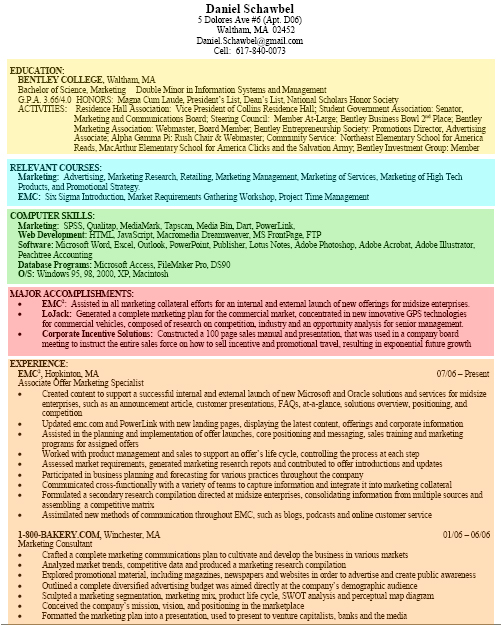
A resume is a story. More importantly, it is a story of your life, including your college experiences, as well as your work experiences. Think of a resume as a detail description of all that you have accomplished thus far in your lives. So you might ask "how do I shape my experiences chronologically in order to be most effective?" To have the most impact with your resume, there must be some logical flow behind it. I will now walk you through my resume as an example.
- Education: Start off by describing your experiences at college because it is the foundation for which you will enter your careers. Include your major, gpa (if 3.0 or higher), activities & leadership positions and any honors.
- Relevant Courses: So after you lay out the statistics and qualitative information to give credibility, the courses you take in college help demonstrate that you have learned information in your field.
- Technical Skills: I'm an employer and i've seen that you have gone to the same college as most of the other applicants and have taken similar courses. Having the right technical skills infuses your expertise level and allows you to accelerate in desired positions. You have already listed your overall background (education), so take the time to list out skills that have helped you accomplish this education.
- Major Accomplishments: This area is brand new to my resume. If you haven't had any major accomplishments, feel free to list a school related project. This area is good for a reviewer who doesn't have time to read your entire resume.
- Experience: This area is a representation of your work experience history, from present to past, which is a story in itself. This area of your resume is by far the most critical to you landing that much anticipated job req. Make sure to connect your work experiences into your education and so forth. If you can cross apply your learnings, you should have superior interviews.
Subscribe to:
Posts (Atom)

